



IELTS Real Practice Questions: How to Use Official Samples Without Wasting Them
A practical guide to using official IELTS sample questions for Listening, Reading, Writing, and Speaking with review steps that actually improve your score.
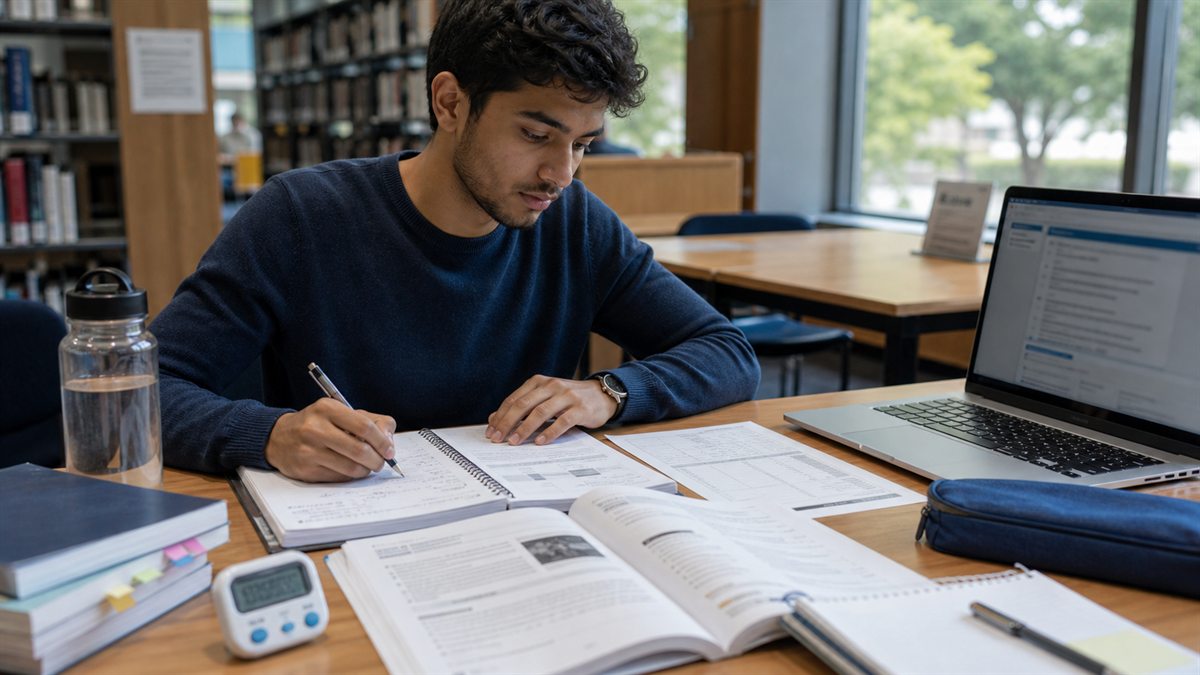
If you are preparing for IELTS, real practice questions are valuable because they show the shape of the exam: the timing, task types, wording, and answer discipline.
But there is one important rule: do not burn through official questions just to "see your score." Use them slowly, check them carefully, and turn every mistake into a next action.
This article is based on publicly available official IELTS sample materials, not invented questions. For copyright reasons, it does not copy full test passages or prompts. Use the official pages for the actual tasks:
What the official IELTS samples show
The official IELTS Academic page explains that Listening and Speaking are the same for Academic and General Training, while Reading and Writing differ by test type. It also lists the main computer and paper sample sections.
For Listening, IELTS uses four recorded monologues and conversations. The official page lists task types such as multiple choice, matching, map or diagram labelling, form completion, note completion, table completion, flow-chart completion, summary completion, sentence completion, and short-answer questions.
For Academic Reading, official sample tasks include question types such as True/False/Not Given, Yes/No/Not Given, matching headings, matching information, summary completion, diagram labels, and short answers.
For Academic Writing, Task 1 asks you to describe, summarize, or explain visual information such as a graph, table, chart, or diagram. Task 2 asks you to write an essay responding to a point of view, argument, or problem.
For Speaking, the General Training official page describes three parts: questions about yourself and familiar topics, a longer individual turn, and a broader discussion.
Do not treat every practice question the same
Use official samples for three different jobs:
- Learn the format.
- Diagnose weaknesses.
- Rehearse under time pressure.
Those are not the same session.
If you are new to IELTS, first use a sample untimed. Look at the instructions, question types, and answer sheet. The goal is not speed. The goal is to understand what the test is asking you to do.
If you already know the format, use a sample to diagnose. After each question, write down why you missed it: vocabulary, distractor, grammar, time, careless reading, spelling, or not following the instruction.
Only after that should you run timed practice.
A better way to review Listening
After a Listening sample, do not only count correct answers.
Review like this:
- replay the part where you missed the answer
- find the phrase that signaled the answer
- note the distractor, especially if the speaker corrected themselves
- check spelling and singular/plural forms
- write one sentence about why your first answer was wrong
Listening mistakes often come from attention, not just vocabulary.
A better way to review Reading
For Reading, mark each wrong answer with a reason:
- I matched keywords without understanding the sentence.
- I confused "False" with "Not Given."
- I missed a reference word such as this, they, or such.
- I spent too long on one paragraph.
- I did not check the exact wording of the question.
Then redo only the missed question type the next day. One targeted redo is better than rushing into another full test.
A better way to review Writing
For Writing Task 1, check whether your answer actually describes the main features. Many students write details before they explain the big picture.
For Task 2, check:
- Does the introduction answer the question?
- Does each body paragraph have one main idea?
- Are examples specific enough?
- Did you discuss both sides if the prompt asks for both?
- Are grammar mistakes blocking meaning?
Do not memorize full essays. Build reusable planning habits.
A better way to review Speaking
For Speaking, official-style practice is most useful when you record yourself.
After one answer, listen again and check:
- Did I answer the question directly?
- Did I extend with a reason or example?
- Did I repeat the same word too often?
- Did hesitation stop the message?
- Could I say the same idea more simply?
Fluent does not mean fast. It means the listener can follow you.
Where Gotostudy fits
At gotostudy.net, you can turn IELTS reading passages, listening transcripts, vocabulary notes, or writing feedback into a study guide. You can then ask an AI Tutor to quiz you, explain wrong answers, and save weak points as flashcards.
Use it after you complete an official sample. Paste your mistake log, not just your score. The useful question is not "What band am I?" It is "What should I fix next?"
A simple official-sample routine
Try this with one IELTS sample set:
- Do the task under realistic conditions.
- Check answers or compare against the official sample guidance.
- Write a mistake log.
- Redo only the missed question type.
- Save weak vocabulary or patterns for review.
- Repeat the same skill two days later.
Official questions are limited. Use them like evidence, not entertainment.
Bottom line
IELTS real practice questions are not magic. They help because they reveal exact habits: how you read, listen, write, speak, check instructions, and recover under time pressure.
Use official samples carefully. Review harder than you test. That is where the score improvement starts.